




The Tears of an Icon: Ronaldo’s Emotional Farewell to His World Cup Dream

In the vast bowl of AT&T Stadium in Arlington, Texas, the final whistle sounded like a requiem. Portugal had been eliminated from the 2026 FIFA World Cup in the Round of 16, undone by a stoppage-time goal from Spain’s Mikel Merino. The scoreline read 0-1, but the true story was written on the face of the man wearing the No. 7 shirt.
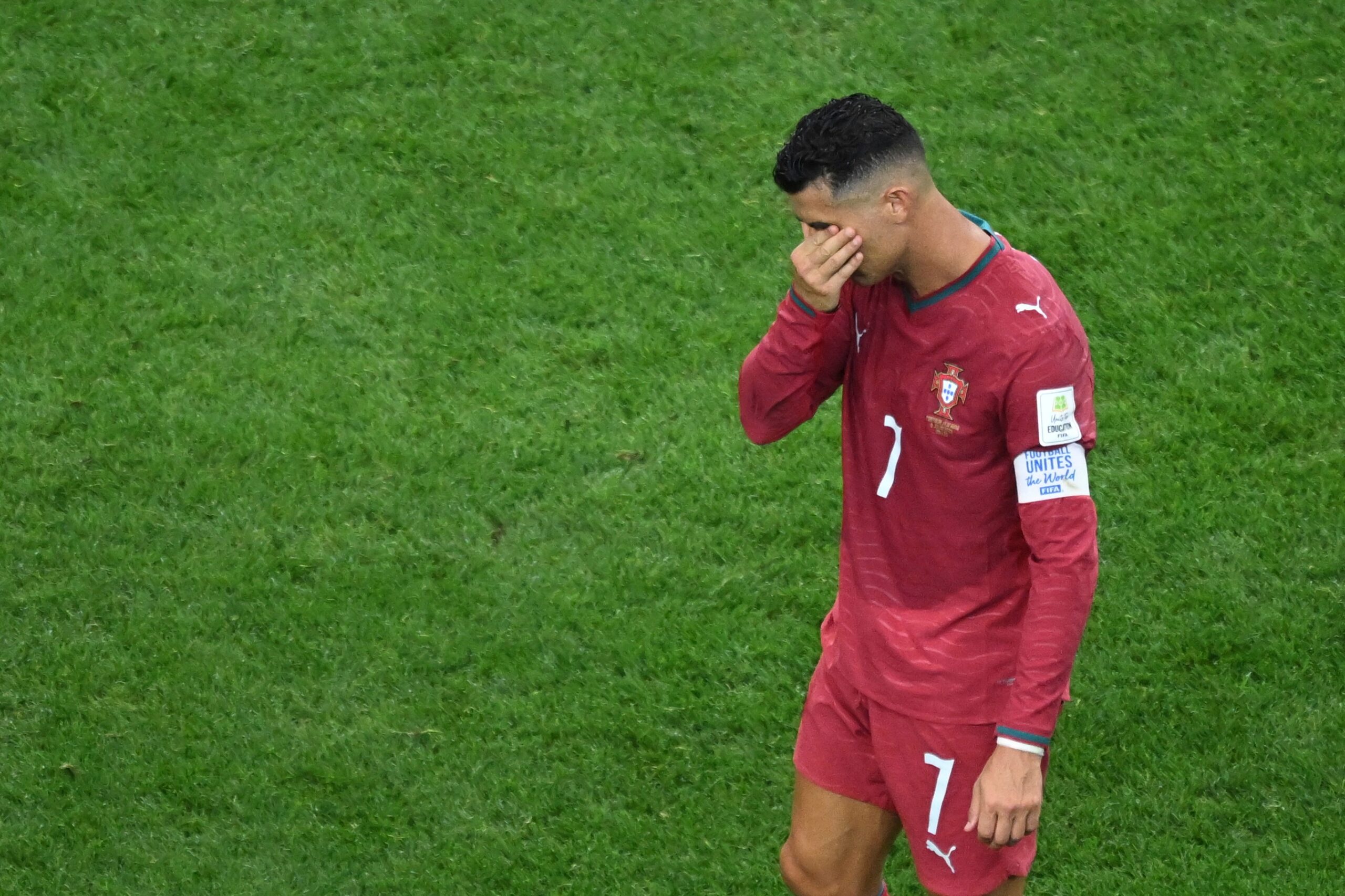
Cristiano Ronaldo, 41 years old and playing what everyone knew would be his last World Cup, stood on the pitch as the weight of two decades of dreams finally broke through his famous composure. Tears welled in his eyes. He wiped them away, turned to the Portuguese supporters, and began to applaud. The gesture was small, almost private, yet it spoke louder than any trophy. Here was a man who had carried a nation’s hopes across six World Cups, and the curtain had fallen without the one prize that had always eluded him.

Reports from ESPN and eyewitness accounts across global broadcasts captured the raw moment: Ronaldo, the eternal competitor, visibly emotional as the reality sank in. Videos circulating on social media and YouTube showed him struggling to hold back tears even as he walked toward the tunnel, still the captain, still the leader.

Later, in the mixed zone, his words carried the quiet dignity that has defined him for a generation.
“I’m sad to leave the World Cup this way,” he said. “As I said yesterday, I gave it my all, and I leave with a clear conscience. That’s the life of a footballer. You have to move forward.”
He repeated the phrase in different ways, each time underscoring the same truth: “I’ve given everything, I’ve given my best, and I leave with a clear conscience. Sometimes you win and sometimes you lose.”
Before the match he had spoken of himself in that unmistakable third-person way: “No matter what happens tomorrow, Cristiano will leave here with a clear conscience. Not 100%. 1,000%.” That, more than any statistic, is the essence of the man. Ronaldo is Ronaldo — relentless, proud, unapologetically driven — whether the final result brings glory or heartbreak.
This was never just about one tournament. Ronaldo arrived at the 2026 World Cup as the only player in history to score in six different editions of the competition. He finished with 11 World Cup goals and 27 appearances. He had already rewritten the record books for international goals and appearances for Portugal. He had delivered the 2016 European Championship — a triumph he still places on the same emotional level as a World Cup — and two UEFA Nations League titles. Before him, Portugal had never won a major senior trophy. He changed that forever.
Yet the tears in Texas were real because the dream had always been bigger than personal glory. It was about lifting that golden trophy with his country. At 41, still starting matches, still pressing high, still believing he could will his team forward — that refusal to surrender is what made him extraordinary.
His coach, Roberto Martínez, captured the deeper truth when he called Ronaldo an “exemplary captain,” a “role model,” and “an icon in football… An example as the human being who is behind the sportsman.” Martínez spoke of gratitude — not just for the goals and the presence in the box, but for the commitment, the way he experienced football, and the human example he set.
That is the Ronaldo the world will remember long after the final whistle of 2026. Not the player who never won a World Cup, but the man who gave every ounce of himself across more than twenty years in a Portugal shirt. The boy from Madeira who became a global phenomenon, the captain who lifted his nation to its first major title, the veteran who, at an age when most have long retired, still ran harder, cared deeper, and inspired louder than almost anyone else on the planet.
The tears were not weakness. They were the purest expression of love — for the game, for his teammates, for the millions who have worn his jersey and believed in his example. Ronaldo leaves this World Cup with no regrets and a clear conscience. He gave everything. He always has.
In the end, the greatest players are not defined solely by the trophies they lift, but by the way they carry themselves when the dream slips away. Cristiano Ronaldo carried himself with grace, fire, and unmistakable humanity. He remains, and will always remain, Ronaldo — one of the greatest the game has ever produced, and a man whose spirit transcended any single result.
Football is poorer without him on the biggest stage, but infinitely richer for having witnessed his journey. Thank you, Cristiano. For the goals, the passion, the records, and most of all, for never giving less than your absolute all.
The final whistle has sounded on his World Cup story. The legend, however, is eternal.