








Unpaid Care Work: Backbone of Nepali Society

Every morning, Nepali households begin with the routine where a woman wakes before everyone else. She cooks, cleans, prepares children for school, takes care of elders and ensures everything is done smoothly. She then leaves for her paid work but continues her responsibilities at home even after returning home tired without any complaint. During festivals, while families gather to celebrate, women carry the responsibility of preparing large meals, cleaning, hosting guests, and caring for everyone. This daily reality is common, yet it rarely receives attention, even though it forms the backbone of our society.
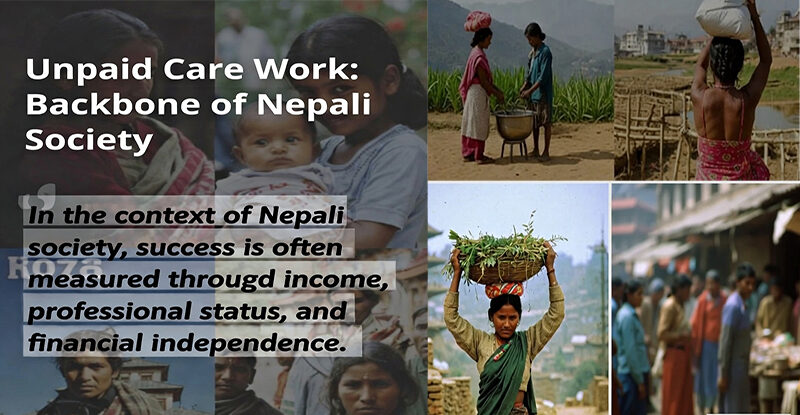
This labour is known as unpaid care work, which includes activities such as cooking, cleaning, washing, shopping, and looking after children and the elderly, and also the sick. Even though unpaid care work sustains households, communities, and the economy, it still remains invisible in economic systems and public recognition. In the context of Nepali society, success is often measured through income, professional status, and financial independence. People rarely identify themselves as homemakers despite their skill, discipline and endurance required to manage a household.
The undervaluation of care work is rooted in the long standing division between “productive” and “reproductive” labour. Paid work which is often performed in public spaces is celebrated, whereas care work which is mostly done by women is treated as a natural duty rather than real labour. In South Asian families, we see household members are deeply interdependent, but recognition is typically reserved for the ones who have contributed financially. This leads to gender biases deeply rooted by imbalance which continues to over shadow the contribution of caregivers.
The policy brief Public Investments in Nepal’s Care Economy, produced by UN Women and the International Labour Organization in collaboration with Nepal’s National Planning Commission and IIDS, has brought this issue into sharp focus. The report, prepared in the early 2020s amid global concern about gender inequality and the COVID-19 pandemic talks about how dependent societies are on unpaid and underpaid care work. In Nepal, women perform nearly six times more unpaid care work than men, leading to severe time poverty and limiting women’s participation in education, employment, and public life.
The report also identifies the significant care deficit in Nepal, particularly in early childhood education, health, and social services. Due to insufficient public care infrastructure and families, women are primarily forced to fill the gap through unpaid labour. This reinforces gender inequality and low female labour force participation. Importantly, it briefly challenges the idea that investing in care is a financial burden. And instead argues that public investment in the care economy can create jobs, boost GDP, reduce poverty, and help redistribute unpaid care work more fairly.
Additionally, despite its importance, care work is still widely viewed as low skilled and easily replaceable. This kind of view is misleading our society as care work not only demands physical endurance but also emotional intelligence, judgment, and continuous learning. Whether it is paid or unpaid, care cannot be easily replaced because it requires human connection and time. So, recognizing care as skilled work is essential for caregivers. Care is an essential social need and not an individual responsibility. Around the world, countries are developing collective care systems, and Nepal has begun to acknowledge this need. The Government of Nepal’s 16th Periodic Plan recognizes care related work and signals intent to develop a national care policy. Combined with Nepal’s constitutional commitment to gender equality and human rights, this presents an opportunity to finally address care work seriously.
Until care work is recognized, valued, and shared more equally, gender equality in Nepal will remain incomplete. A society that ignores care ignores the labour that sustains life itself. Thus, valuing care work is not only about justice for women but also about building a more inclusive and sustainable future for all.
(Nawami KC is Media Studies student at Kathmandu University)