






Finance Minister Wagle Unveils Historic Rs 2.12 Trillion Budget Targeting Deep Economic Reform, Tax Relief, and Tech Expansion

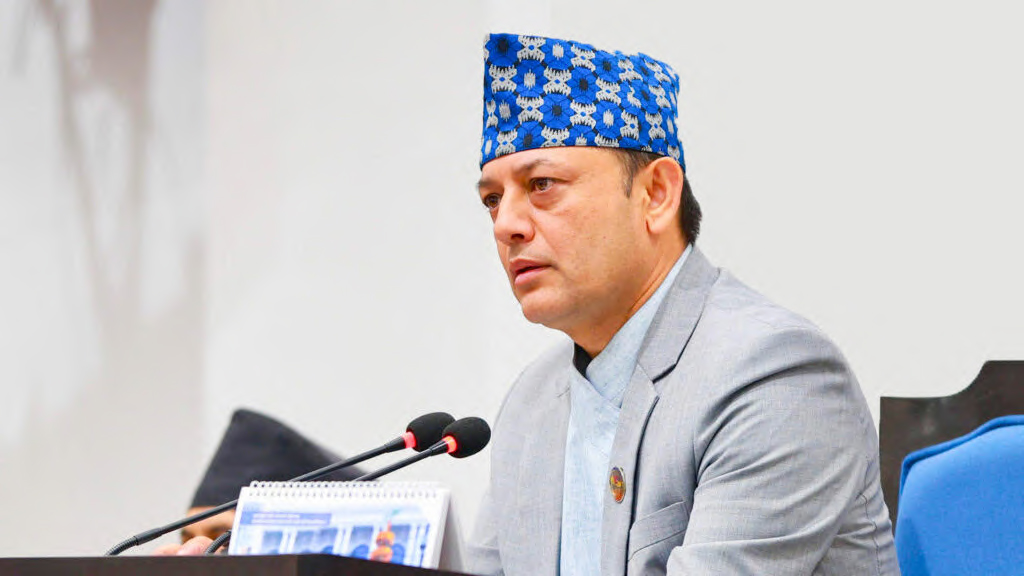
KATHMANDU — Finance Minister Dr. Swarnim Wagle presented a record-breaking national budget of Rs 2,124.34 billion for the upcoming fiscal year 2083/84 during a joint session of the Federal Parliament on Friday evening. Carried into the house inside a locally crafted Nepali paper file rather than the traditional leather briefcase, the comprehensive fiscal plan marks a major policy departure aimed at restoring private sector confidence, shrinking general administration costs, and establishing tech-driven governance. The newly formed government has set its sights on an ambitious 7 percent economic growth target while promising to limit inflation to under 6 percent.
The financial architecture of the multi-trillion rupee budget reveals that recurrent expenditure continues to take the lion’s share at Rs 1,270.58 billion, representing 59.8 percent of the total allocation. Capital expenditure is pegged at Rs 431.10 billion, or 20.3 percent, while financial management for debt servicing accounts for Rs 422.64 billion, making up the remaining 19.9 percent. To finance this massive layout, the government aims to collect Rs 1,405.31 billion directly through domestic revenue and tax administration. The rest of the fiscal gap will be bridged utilizing Rs 61.74 billion in foreign grants, Rs 247.28 billion in external loans, and Rs 410 billion raised via internal borrowing.
A cornerstone of Dr. Wagle’s speech focused on sweeping institutional downsizing to aggressively cut down state administrative costs. The budget mandates the complete abolishment of 31 redundant government bodies, the merger of 6 public entities, and the comprehensive restructuring of 18 others, alongside a bold move to slash the total number of federal ministries from 22 down to 18. Simultaneously, to support state workers, the basic salary at the entry-level for civil servants, teachers, and security personnel will see a 10 percent increase, alongside a new performance-based monthly incentive system that will result in a cumulative 21 percent bump in take-home remuneration starting this July.
Taxpayers received unprecedented relief as Dr. Wagle announced that the personal income tax exemption threshold has been doubled to Rs 1 million, dramatically widening the tax-free bracket for individual earners while lowering the maximum personal income tax bracket by 10 percentage points. On the industrial front, customs duties across 273 separate categories of raw materials have been slashed to keep production inputs significantly cheaper than finished imported goods, paired with a 50 percent income tax exemption on revenues generated directly through exports. In the energy sector, the budget lays out plans to add 1,040 megawatts of electricity to the national grid within the year, alongside a structural plan to split the state-owned Nepal Electricity Authority into three distinct companies to optimize distribution, generation, and transmission.
Emphasizing digital public infrastructure, the Finance Minister announced the upcoming establishment of the country’s first sovereign artificial intelligence computing center in Syuchatar, Kathmandu, which will provide highly subsidized processing resources to local tech startups and entrepreneurs. This digital push will be partially funded by selling off a portion of the state’s stake in Nepal Telecom, maintaining a 66 percent majority government ownership while opening up the remainder to the general public. Additionally, the new fiscal policy introduces direct legal frameworks to legalize and encourage remote work for international employers from within Nepal, paired with novel lottery schemes for formal billing receipts and remittance senders to bring hidden capital back into the formal banking system.