


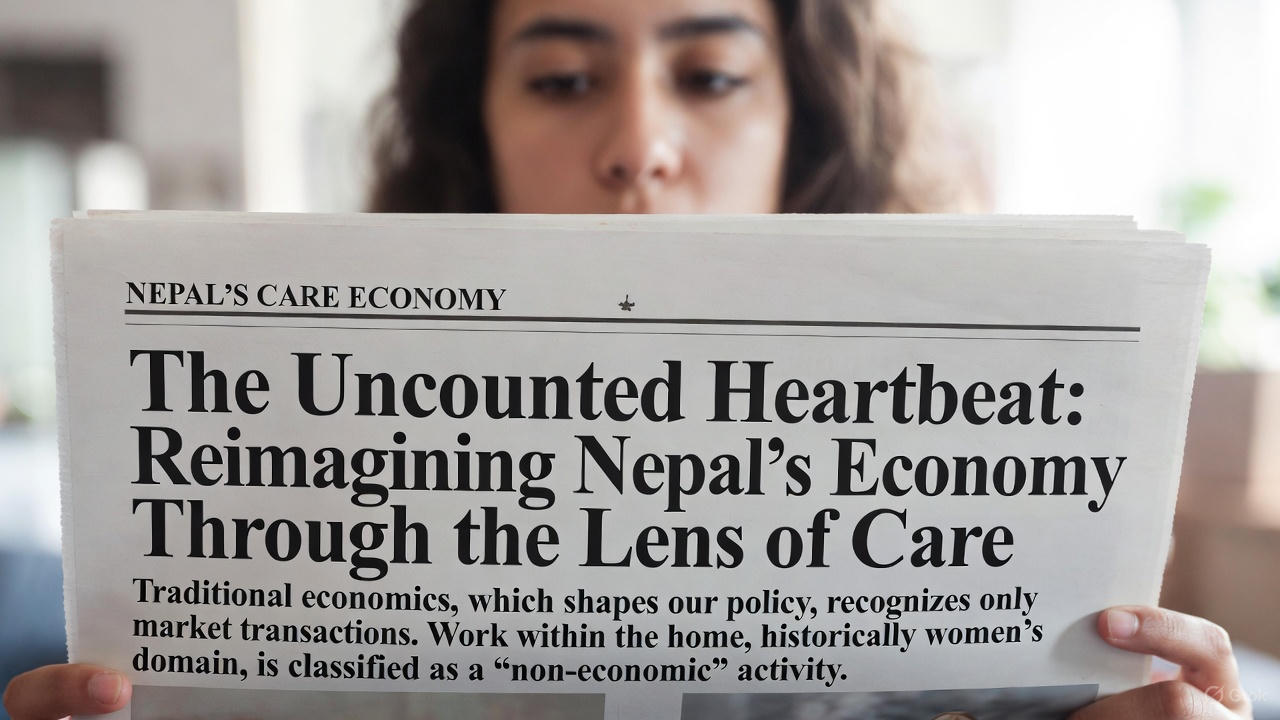
The Uncounted Heartbeat: Reimagining Nepal’s Economy Through the Lens of Care

A Morning in Darchula
Before sunrise, as the first light touches the Mahakali River valley, Harina Joshi of Darchula is already two hours into her day. She has navigated the steep trail to collect water, cooked a pot of bhat for her family, fed the few goats, and begun mending clothes. Her husband, Kishan, migrated to Jammu, India for work three years ago. Her sons are in school in Kathmandu. Harina’s work (relentless, solitary, and essential) vanishes into the statistical void. It is called “ghar ko kaam”(household work) and it is the invisible foundation upon which her family, and indeed, a nation sustained by remittances and migration, is built.
This is the Care Economy: the universe of unpaid and underpaid labour involved in nurturing, sustaining, and reproducing the population. It encompasses cooking, cleaning, childcare, elderly care, fetching water and firewood, and maintaining the emotional and physical well-being of households. In Nepal’s remote districts like Darchula, this economy has a distinctly female and increasingly solitary face. The 2021 Nepal Labour Force Survey reveals that women spend 4.6 times more hours on unpaid care work than men – one of the highest disparities in Asia, a gap that widens in the hills where infrastructure is sparse and male out-migration is high.
Yet, in our national discourse (dominated by infrastructure megaprojects, remittance inflows, and GDP percentages) the care economy is the ghost in the machine. Its omission is not a benign oversight; it is a profound distortion of reality with real and damaging consequences for women like Harina and for Nepal’s sustainable development.
Why Is It Invisible? The Roots of a Systemic Blind Spot
The erasure of care work is rooted in deep-seated structures:
- The Public/Private Divide:Traditional economics, which shapes our policy, recognizes only market transactions. Work within the home, historically women’s domain, is classified as a “non-economic” activity. This artificial wall between the “productive” public sphere and the “reproductive” private sphere renders women’s labour a natural duty, not a contribution.
- Cultural Norms & Gendered Roles:The idea of “sewa” (or selfless service is seen as a woman’s duty. This ideal is used to expect endless unpaid work from them. A man may “help,” but the primary responsibility (and the massive time burden) remains a woman’s destiny, a reality intensified in left-behind communities of the Far-West.
- The GDP Mirage:Our primary measure of progress, Gross Domestic Product, is fundamentally flawed. It counts the remittance sent by Kishan from Jammu but not the 24/7 labour of Harina that keeps the home functioning in his absence. It values a paid daycare centre in Kathmandu but not a grandmother’s care in Darchula. By this metric, a country that outsources care to unpaid women appears less “productive” than one that monetizes it – a perverse economic illusion.
The Cost of Invisibility: Stunted Lives, a Stunted Nation
Ignoring the care economy is not free. The price is paid in individual dreams and national potential.
- For Women:The time poverty is devastating. For Harina, hours spent on care and subsistence work are hours not spent in a cooperative, learning a new skill, accessing healthcare, or participating in community decisions. This directly translates to lower female labour force participation, economic dependency, and vulnerability. It is the primary engine of the gender gap.
- For the Economy:We are willfully ignoring our largest “employment” sector. Studies from other countries estimate the value of unpaid care work at 20-50% of GDP. In Nepal, with its high dependency on such labour, the figure would be astounding. This blind spot leads to flawed policies. Without understanding the care constraints of women in districts like Darchula, we cannot design effective rural development or social protection schemes.
- For Society:The burden is intensifying. Migration (primarily male) has created “feminized households” across the hills, where women like Harina are left to manage farms, families, and ageing in-laws alone. Our system relies on this unpaid work as a cheap subsidy for national stability, but the caregivers are buckling under the strain, with consequences for family health and social cohesion.
A Path to Recognition: From Burden to Foundation
Making the care economy visible is the first step towards justice and smarter economics. Here is how we can begin:
- Measure It:Nepal must institutionalize Time-Use Surveys to collect robust, regular data on how men and women spend their time. This data is the flashlight that reveals the hidden landscape of work, from the kitchens of Kathmandu to the hills of Darchula.
- Value It in Discourse:Media, academics, and politicians must name it. Stop calling it “helping at home.” Start calling it “unpaid care work” – an economic contribution. Celebrate it in our national story.
- Redistribute It:The goal is not to monetize all care, but to reduce, redistribute, and recognise the burden. This requires:
- Infrastructure:Piped water, clean energy (biogas, electricity), and accessible childcare centres directly reduce unpaid labour hours, most dramatically for women in remote areas.
- Social Norms:Media campaigns and education that promote the shared domestic responsibility of men and boys (“Men for Change”), even in migrant-sending communities.
- Policy:Parental leave, caregiver allowances, and social security that acknowledge the reality of women-headed households.
- Integrate It into Planning:Every infrastructure project, every poverty alleviation programme, must ask: “How will this affect the unpaid care work burden, particularly on women?” Will a new trail or water system reduce Harina’s daily labour? Will a skills training schedule conflict with her care duties?
Conclusion: Towards an Economy That Cares
Recognizing the care economy is not a niche feminist issue. It is a fundamental re-evaluation of what we consider “work” and “value.” It is about seeing Harina Joshi not as someone who is “just at home,” but as the indispensable provider of essential services that allow her children to be educated, her migrant husband to work, and her community in Darchula to endure.
Building a prosperous, equitable Nepal requires us to move beyond the myth of the GDP and build an economy that sees and supports the uncounted heartbeat of care. It is time to shift from an economy that runs on the invisible labour of women to one that visibly invests in their (and the nation’s) liberated potential. The first step is simply to open our eyes and count.